

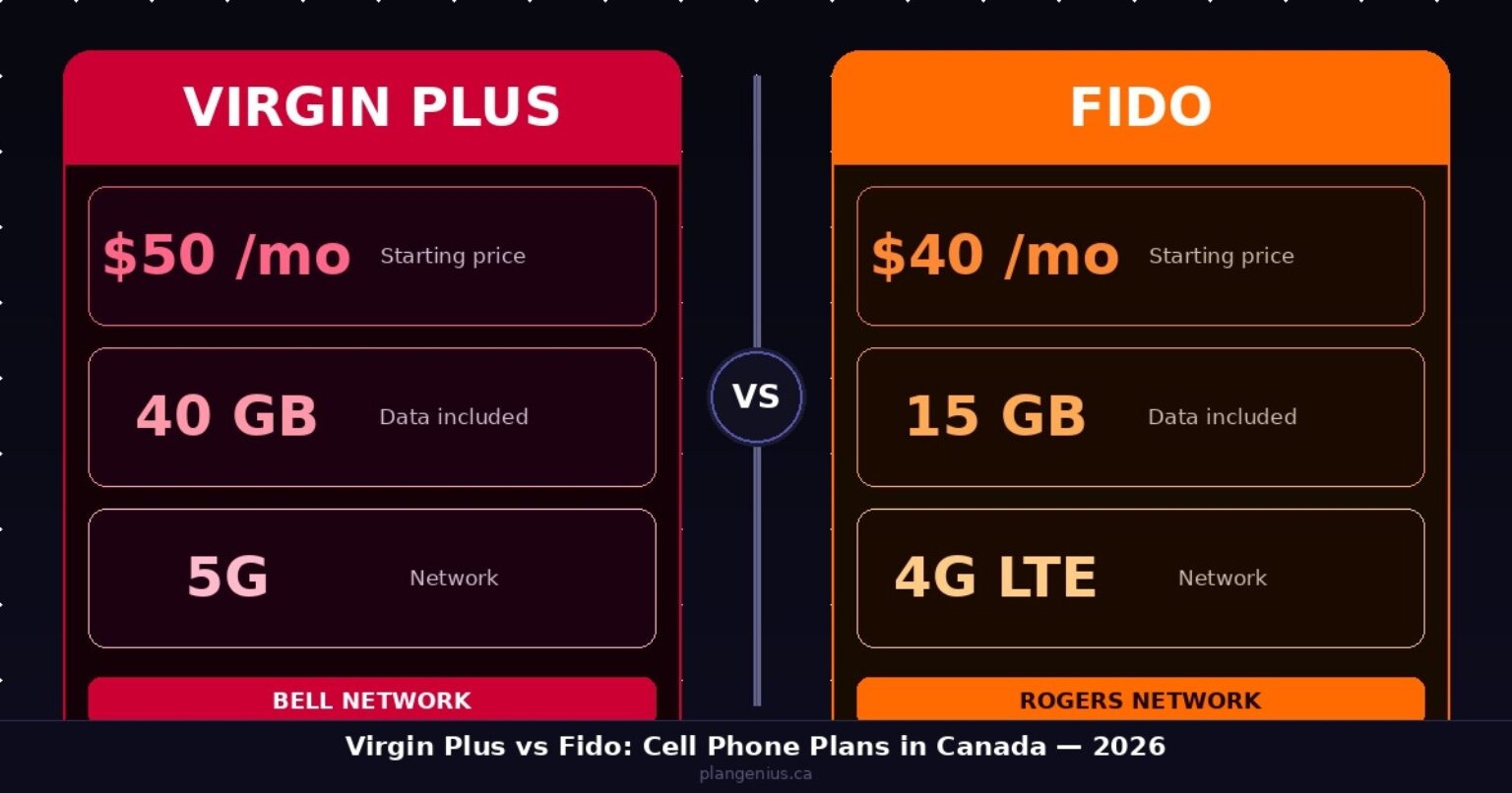
Fido and Virgin Plus are both sub-brands of Canada's big three carriers, offering competitive no-contract postpaid plans at lower price points than their parent networks. Fido is owned by Rogers and runs on the Rogers network, one of the most extensive 5G footprints in the country. Virgin Plus is owned by Bell and runs on the Bell network, which leads in eastern Canada and holds a strong 5G position in most provinces outside Alberta and BC. Both carriers target cost-conscious Canadians who want solid national coverage without paying premium carrier prices.
Plans and pricing
Both Fido and Virgin Plus offer no-contract postpaid plans starting at $19 per month, with lineups that cover entry-level voice plans, mid-tier data options, and 5G top-tier plans with Canada-US-Mexico coverage included. The plans below represent the most representative general postpaid options from each carrier.
Virgin Plus has raised pricing on its unlimited talk/text, 20GB, 60GB, and 60GB Canada-US-Mexico plans, bringing it back in line with Fido's own recent increase - the two carriers are now priced identically at $45 for 20GB, $50 for 60GB, and $55 for the 60GB Canada-US-Mexico plan. The feature mix has also shifted: Virgin Plus's unlimited international calls to 27 countries is no longer included on its 20GB and 60GB plans, replaced by unlimited international messages and suspicious call detection, while Fido keeps unlimited long distance calling on those same tiers. At the top tier, Virgin Plus's 60GB Canada-US-Mexico plan runs on its 5G network and includes international calls to 27 countries, versus Fido's equivalent plan on 4G. Fido's entry-level unlimited talk and text plan is now $5/mo cheaper than Virgin Plus's equivalent, at $25/mo versus $30/mo (both promo). Quebec pricing may differ; both carriers have dedicated Quebec plan variants at their own price points.
5G and network coverage
Coverage data is estimated from the ISED tower registry and Statistics Canada 2021 census boundaries, updated March 2026. Fido runs on the Rogers network, which holds a significant lead in 5G population coverage nationally. Virgin Plus runs on the Bell network, which leads in eastern Canada but has a much smaller 5G footprint in Alberta and BC.
Fido (Rogers network) holds a clear national lead in both 4G and 5G coverage. Rogers reaches 98.3% of the population on 4G and 96.7% on 5G, with 9,080 dedicated 5G towers. Bell reaches 92.8% on 4G and 76.5% on 5G with 3,972 dedicated 5G towers. Bell's coverage is strongest in Ontario, Quebec, and the Atlantic provinces, where it hits 99%+ on 4G and near-full 5G saturation. However, Bell's 5G footprint in Alberta is reported at 0% and BC at 53.4%, making the Rogers network a considerably better choice for 5G users in western Canada.
Head-to-head comparison
| Fido | Virgin Plus | |
|---|---|---|
| Starting price | $19/mo | $19/mo |
| Talk & text only plan | $25/mo (promo) | $30/mo (promo) |
| Cheapest 5G plan | $45/mo (20GB, promo) | $30/mo (unlimited talk/text, promo) |
| 20GB 5G plan | $45/mo + hotspot, long distance (promo) | $45/mo + hotspot, suspicious call detection (promo) |
| 60GB plan | $50/mo + hotspot (promo) | $50/mo + hotspot (promo) |
| Canada-US-Mexico plan | $55/mo (60GB, 4G, hotspot, intl calls to 27 countries) | $55/mo (60GB, 5G, hotspot, intl calls to 27 countries) |
| 4G population coverage | 98.3% (36.4M) | 92.8% (34.3M) |
| 5G population coverage | 96.7% (35.8M) | 76.5% (28.3M) |
| Total towers | 12,284 | 9,986 |
| Dedicated 5G towers | 9,080 | 3,972 |
| Device financing | 24 months (Fido Payment Program) | 24 months (Sweet Pay) |
| Price lock guarantee | Not stated | Not stated |
| Roaming - USA daily rate | $16/day | $13/day |
| Roaming - USA 14-day pass | $60 | $60 |
| Roaming - Europe best pass | $80 (30-day) | $80 (30-day) |
| International calls to 27 countries | Included on 60GB Canada-US-MX plan | Included on 60GB Canada-US-MX plan |
| Sub-brands / parent | Rogers-owned | Bell-owned |
| Customer rating | 1.9/5 | 1.8/5 |
Roaming rates compared
Both carriers offer daily roaming rates and a range of multi-day travel passes for popular destinations. Virgin Plus has a lower US daily rate at $13 per day versus Fido's $16 per day. For pass-based roaming, the two carriers are closely matched on most regions. Fido adds a 7-day US, Mexico, Caribbean, and Cruises combo pass at $100 and offers a flat international daily rate of $18 per day for destinations not covered by regional passes. Virgin Plus includes a general International daily rate at $16 per day covering destinations outside its regional pass coverage.
United States
| Fido | Virgin Plus | |
|---|---|---|
| Daily rate | $16/day | $13/day |
| 7-day pass | No 7-day US-only pass | No 7-day pass |
| 14-day pass | $60 | $60 |
| 30-day pass | $70 | $70 |
Europe
| Fido | Virgin Plus | |
|---|---|---|
| Daily rate | $18/day (international) | $16/day (international) |
| 7-day pass | No 7-day pass | No 7-day pass |
| 14-day pass | $70 | $70 |
| 30-day pass | $80 | $80 |
Caribbean and Mexico
| Fido | Virgin Plus | |
|---|---|---|
| Daily rate | $18/day (international) | $16/day (international) |
| 7-day pass (US, MX, Caribbean, Cruises) | $100 | No 7-day pass |
| 14-day pass | $70 | $70 |
| 30-day pass | $80 | No 30-day pass listed |
Asia
| Fido | Virgin Plus | |
|---|---|---|
| Daily rate | $18/day (international) | $16/day (international) |
| 7-day pass | No 7-day pass | No 7-day pass |
| 14-day pass | $70 | $75 |
| 30-day pass | $80 | $80 |
International (other destinations)
| Fido | Virgin Plus | |
|---|---|---|
| Daily rate | $18/day | $16/day |
| 14-day pass | $100 | $100 |
| 30-day pass | $110 | $110 |
Virgin Plus wins on daily rates, with a $13/day US rate versus Fido's $16/day and a $16/day international rate versus Fido's $18/day. On 14-day and 30-day passes, the two carriers match exactly on US, Europe, and international destinations. Fido holds a unique advantage with its 7-day US, Mexico, Caribbean, and Cruises combo pass at $100 - a useful option for shorter trips to those regions. Asia 14-day passes tip slightly in Fido's favour at $70 versus Virgin Plus's $75.
Device financing
Both Fido and Virgin Plus offer 24-month device financing programs. Fido's program is called the Fido Payment Program, and Virgin Plus offers the Sweet Pay program. The terms are structurally equivalent, with the device cost spread across 24 monthly payments added to the monthly plan. Confirm current financing eligibility and terms directly with each carrier before purchasing a device.
Perks and add-ons
Fido offers promotional savings currently applied to most mid-tier and top-tier plans. Hotspot access is included on 20GB and higher plans, and unlimited long distance calling is included on 20GB and higher plans. The top-tier Canada-US-Mexico plan also includes unlimited international calls to 27 countries. Customers who order online can save $105 - Fido waives the $80 Setup Service fee and covers shipping. Eligible plan holders with a Rogers Red credit card earn 3% cash back value on select plans.
Virgin Plus includes unlimited international messages, hotspot capabilities, and suspicious call detection on 20GB and higher plans. Unlimited international calls to 27 countries is included on the top-tier 60GB Canada-US-Mexico plan, along with Canada-US-Mexico data, talk, and text coverage. Virgin Plus promotes Member Benefits, which offer discounts on food, fashion, and entertainment. An online sign-up saving of $80 is advertised for bring-your-own-phone customers.
Customer support
Both carriers offer comparable support channels including self-serve tools, live chat, phone, and in-store assistance. Fido additionally offers mail as a contact channel. Customer ratings on Topicks.ca are similar and low for both - Fido at 1.9/5 and Virgin Plus at 1.8/5 - with reviewers on both sides citing frustrating hold times and inconsistent support experiences.
Who should choose which?
- You live or travel frequently in western Canada, where Rogers 5G coverage is far ahead of Bell
- You want the broadest 5G footprint nationally, with 96.7% population coverage
- You travel to Mexico, the Caribbean, or on cruises and want a 7-day combo pass option
- You prefer a carrier with a mail contact option in addition to digital and phone support
- You want access to a larger overall tower network with 12,284 active sites
- You want the cheapest talk & text only plan at $25/mo (promo) versus Virgin Plus's $30/mo
- You are in Alberta or BC where Bell's 5G footprint is significantly smaller
- You order online and want to save $105 in setup and shipping fees
- You want a lower US daily roaming rate at $13/day versus Fido's $16/day
- You want unlimited international messages and suspicious call detection included from the 20GB tier
- You want the 60GB Canada-US-Mexico plan on a 5G network instead of Fido's 4G, at the same price
- You want hotspot and suspicious call detection included on mid-tier and higher plans
- You are in Ontario, Quebec, or Atlantic Canada, where Bell coverage is among the strongest in the country
- You want the cheapest 5G unlimited talk and text option at $30/mo (promo)
- You want member perks including retail discounts on food, fashion, and entertainment
Fido (Rogers network) is the clear winner for Canadians who prioritize 5G reach - especially in western Canada, where its 96.7% national 5G coverage dwarfs Bell's footprint in Alberta and BC - and its online order saving of $105 in setup and shipping fees is a tangible upfront advantage. Fido also now undercuts Virgin Plus on entry-level pricing, with its unlimited talk and text plan $5/mo cheaper. Virgin Plus (Bell network) counters with a lower US daily roaming rate, strong coverage across Ontario, Quebec, and the Atlantic provinces, and a 60GB Canada-US-Mexico plan that runs on 5G rather than Fido's 4G at the same price. Pricing is tied on the 20GB, 60GB, and Canada-US-Mexico tiers, so coverage area, network generation on the top-tier plan, and roaming habits are now the most decisive factors.
Both carriers now price their 20GB 5G plans at $40 and their 60GB 5G plans at $45, making the mid-tier a near-identical match on price. The key differentiator at 20GB is that Virgin Plus includes unlimited international calls to 27 countries and unlimited long distance, while Fido includes hotspot and unlimited long distance but not international calling. At the top tier, both carriers offer a 60GB Canada-US-Mexico plan at $50, now with Fido also including hotspot and unlimited international calls to 27 countries, bringing feature parity closer. Quebec pricing may differ; both carriers have dedicated Quebec plan variants at the same price points.
5G and network coverage
Coverage data is estimated from the ISED tower registry and Statistics Canada 2021 census boundaries, updated March 2026. Fido runs on the Rogers network, which holds a significant lead in 5G population coverage nationally. Virgin Plus runs on the Bell network, which leads in eastern Canada but has a much smaller 5G footprint in Alberta and BC.
Fido (Rogers network) holds a clear national lead in both 4G and 5G coverage. Rogers reaches 98.3% of the population on 4G and 96.7% on 5G, with 9,080 dedicated 5G towers. Bell reaches 92.8% on 4G and 76.5% on 5G with 3,972 dedicated 5G towers. Bell's coverage is strongest in Ontario, Quebec, and the Atlantic provinces, where it hits 99%+ on 4G and near-full 5G saturation. However, Bell's 5G footprint in Alberta is reported at 0% and BC at 53.4%, making the Rogers network a considerably better choice for 5G users in western Canada.
Head-to-head comparison
| Fido | Virgin Plus | |
|---|---|---|
| Starting price | $19/mo | $19/mo |
| Talk & text only plan | $30/mo (promo) | $25/mo (promo) |
| Cheapest 5G plan | $40/mo (20GB, promo) | $25/mo (unlimited talk/text, promo) |
| 20GB 5G plan | $40/mo + hotspot, long distance (promo) | $40/mo + hotspot, intl calls to 27 countries (promo) |
| 60GB plan | $45/mo + hotspot (promo) | $45/mo + hotspot (promo) |
| Canada-US-Mexico plan | $50/mo (60GB, hotspot, intl calls to 27 countries) | $50/mo (60GB, hotspot) |
| 4G population coverage | 98.3% (36.4M) | 92.8% (34.3M) |
| 5G population coverage | 96.7% (35.8M) | 76.5% (28.3M) |
| Total towers | 12,284 | 9,986 |
| Dedicated 5G towers | 9,080 | 3,972 |
| Device financing | 24 months (Fido Payment Program) | 24 months (Sweet Pay) |
| Price lock guarantee | Not stated | Not stated |
| Roaming - USA daily rate | $16/day | $13/day |
| Roaming - USA 14-day pass | $60 | $60 |
| Roaming - Europe best pass | $80 (30-day) | $80 (30-day) |
| International calls to 27 countries | Included on 60GB Canada-US-MX plan | Included from 20GB plan |
| Sub-brands / parent | Rogers-owned | Bell-owned |
| Customer rating | 1.9/5 | 1.8/5 |
Roaming rates compared
Both carriers offer daily roaming rates and a range of multi-day travel passes for popular destinations. Virgin Plus has a lower US daily rate at $13 per day versus Fido's $16 per day. For pass-based roaming, the two carriers are closely matched on most regions. Fido adds a 7-day US, Mexico, Caribbean, and Cruises combo pass at $100 and offers a flat international daily rate of $18 per day for destinations not covered by regional passes. Virgin Plus includes a general International daily rate at $16 per day covering destinations outside its regional pass coverage.
United States
| Fido | Virgin Plus | |
|---|---|---|
| Daily rate | $16/day | $13/day |
| 7-day pass | No 7-day US-only pass | No 7-day pass |
| 14-day pass | $60 | $60 |
| 30-day pass | $70 | $70 |
Europe
| Fido | Virgin Plus | |
|---|---|---|
| Daily rate | $18/day (international) | $16/day (international) |
| 7-day pass | No 7-day pass | No 7-day pass |
| 14-day pass | $70 | $70 |
| 30-day pass | $80 | $80 |
Caribbean and Mexico
| Fido | Virgin Plus | |
|---|---|---|
| Daily rate | $18/day (international) | $16/day (international) |
| 7-day pass (US, MX, Caribbean, Cruises) | $100 | No 7-day pass |
| 14-day pass | $70 | $70 |
| 30-day pass | $80 | No 30-day pass listed |
Asia
| Fido | Virgin Plus | |
|---|---|---|
| Daily rate | $18/day (international) | $16/day (international) |
| 7-day pass | No 7-day pass | No 7-day pass |
| 14-day pass | $70 | $75 |
| 30-day pass | $80 | $80 |
International (other destinations)
| Fido | Virgin Plus | |
|---|---|---|
| Daily rate | $18/day | $16/day |
| 14-day pass | $100 | $100 |
| 30-day pass | $110 | $110 |
Virgin Plus wins on daily rates, with a $13/day US rate versus Fido's $16/day and a $16/day international rate versus Fido's $18/day. On 14-day and 30-day passes, the two carriers match exactly on US, Europe, and international destinations. Fido holds a unique advantage with its 7-day US, Mexico, Caribbean, and Cruises combo pass at $100 - a useful option for shorter trips to those regions. Asia 14-day passes tip slightly in Fido's favour at $70 versus Virgin Plus's $75.
Device financing
Both Fido and Virgin Plus offer 24-month device financing programs. Fido's program is called the Fido Payment Program, and Virgin Plus offers the Sweet Pay program. The terms are structurally equivalent, with the device cost spread across 24 monthly payments added to the monthly plan. Confirm current financing eligibility and terms directly with each carrier before purchasing a device.
Perks and add-ons
Fido offers promotional savings currently applied to most mid-tier and top-tier plans. Hotspot access is included on 20GB and higher plans, and unlimited long distance calling is included on 20GB and higher plans. The top-tier Canada-US-Mexico plan also includes unlimited international calls to 27 countries. Customers who order online can save $105 - Fido waives the $80 Setup Service fee and covers shipping. Eligible plan holders with a Rogers Red credit card earn 3% cash back value on select plans.
Virgin Plus includes unlimited international messages and unlimited calls to 27 countries on 20GB and higher plans, along with hotspot capabilities and suspicious call detection. Unlimited long distance calling is included on 20GB plans. Virgin Plus promotes Member Benefits, which offer discounts on food, fashion, and entertainment. An online sign-up saving of $80 is advertised for bring-your-own-phone customers.
Customer support
Both carriers offer comparable support channels including self-serve tools, live chat, phone, and in-store assistance. Fido additionally offers mail as a contact channel. Customer ratings on Topicks.ca are similar and low for both - Fido at 1.9/5 and Virgin Plus at 1.8/5 - with reviewers on both sides citing frustrating hold times and inconsistent support experiences.
Who should choose which?
- You live or travel frequently in western Canada, where Rogers 5G coverage is far ahead of Bell
- You want the broadest 5G footprint nationally, with 96.7% population coverage
- You travel to Mexico, the Caribbean, or on cruises and want a 7-day combo pass option
- You prefer a carrier with a mail contact option in addition to digital and phone support
- You want access to a larger overall tower network with 12,284 active sites
- You are in Alberta or BC where Bell's 5G footprint is significantly smaller
- You order online and want to save $105 in setup and shipping fees
- You want a lower US daily roaming rate at $13/day versus Fido's $16/day
- You want international messages and calls to 27 countries included from the 20GB tier - Fido does not include these
- You want a larger data top-tier plan - 60GB at $50 versus Fido's 60GB at $49, nearly identical in data
- You want hotspot and suspicious call detection included on mid-tier and higher plans
- You are in Ontario, Quebec, or Atlantic Canada, where Bell coverage is among the strongest in the country
- You want the cheapest 5G unlimited talk and text option at $25/mo (promo)
- You want member perks including retail discounts on food, fashion, and entertainment
Fido (Rogers network) is the clear winner for Canadians who prioritize 5G reach - especially in western Canada, where its 96.7% national 5G coverage dwarfs Bell's footprint in Alberta and BC - and its online order saving of $105 in setup and shipping fees is a tangible upfront advantage. Virgin Plus (Bell network) counters with a lower US daily roaming rate, international calls to 27 countries available from the 20GB tier rather than the top tier only, and strong coverage across Ontario, Quebec, and the Atlantic provinces. The two carriers have converged significantly on mid-tier pricing and features, making coverage area and roaming habits the most decisive factors.